
no, i just didn't expect heaven to be chinese
‘Whereas Orientalism, as a strategy of representational containment, arrests Asia in traditional, and often premodern imagery, techno-Orientalism presents…an “Orient” undergoing rapid economic and cultural transformations.’ (Roh, D., Huang, B., Niu, G. “Technologizing Orientalism”)
“Glazing.” (v.): to meatride or suck up to someone extremely hard (Urban Dictionary)
You’re in the belly of the beast, and you can smell its decay. I say you, not we, because I’m living in China. I’ve been witnessing the decline of the post-Cold-War world order from the capital of America’s preeminent rival. My healthcare costs close to nothing, and my skylines are threaded with the glittering veins of punctual public transport. Are you jealous? You must be, if you’re a self-proclaimed China glazer, one of the chronically online post-woke Instagram users who have filled my feed with your desire to move to China, your proclamations that you’ll one day wake up Chinese, and your calls for China to take military action against Israel.
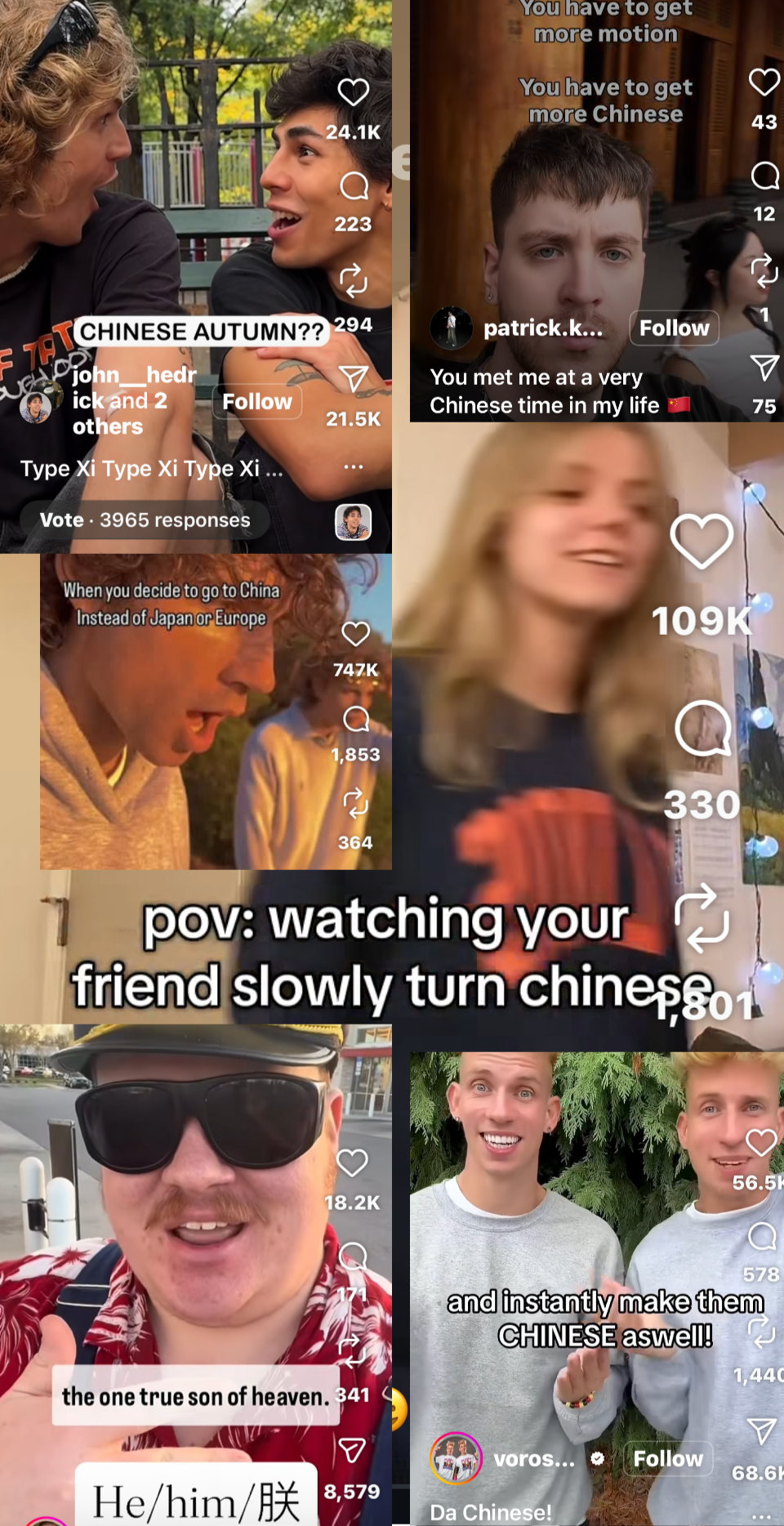
I. you met me at a very chinese time in my life
For centuries, thinkers and gooners from the West have situated Asia in various temporalities—backwards, forwards, backwards (sociopolitically) and forwards (technologically)—in an attempt to plant their own white feet in the present. Japan and Korea have been the subject of this gaze for decades, and now that gaze has also claimed China.
But China glazers are unique. Their fixation coincides with and stems from a desperate, haphazard defiance of the American institution: inaccessible technological advancements, defunded public safety nets, an ever-increasing wealth gap. For the first time, I see netizens appraising China’s cheap healthcare and efficient public transport—institutions inseparable from a socialist philosophy of governance—alongside the well-worn tech-glitzy images of Shanghai’s skyline and Chongqing’s 8D city. Young Americans even seem to have dropped the most common attack leveraged against China in the post-Tiananmen era—that it is ruled by evil authoritarian communists—and have embraced new metrics for determining effective governance. A regime’s adherence to Western, neoliberal values no longer matters as much as its ability to get things done.
I’ve spent the last few months trying to decipher this shift in digital imagery. Why do American netizens want Chinese mopeds? Why are certain meme accounts she/her-ing Mao Zedong over pictures of a sobbing Ben Shapiro? (Have Chinese icons become queer by virtue of their opposition to American imperialism??? It’s so great to never need to prove my queerness again!!) It’s an absurd performance of defiance, conducted with glee on the fertile grounds of Chinese and American meme culture. Yet it also speaks to much deeper ruptures in the American milieu, some of which I’ll try to unpack today.

Disclaimer: I am not a tech anthropologist or a China watcher. I AM a chronically online hater. If you would like to see more citations, talk to me about this stuff, or supply me with memes appropriate to this essay, just DM me on Instagram (or Xiaohongshu (I’ll laugh if you find me there)).
Disclaimer 2: Also, I suffer NO illusions that everyone online has decided to love China. [insert ancient Chinese proverb about true friends/enemies, perception bias/echo chambers, algorithms]
II. brb selling my data to china
In January, the TikTok-to-Xiaohongshu refugee wave opened surprising channels of dialogue between American and Chinese netizens. In translated subtitles and comment sections, users broached hot-button topics such as the cost of living, 996 work culture, and education systems. The TikTok refugees joked that they would rather hand themselves and their data over to China than subject themselves to the incompetent whims of America’s tech overlords: a show of defiance that fizzled out soon after TikTok was reinstated in the U.S.
But it wasn’t all for naught! Many of my Chinese friends, those born in the late 90s, celebrated the digital refugees as the fulfillment of a delayed promise: the “global village” that they’d anticipated during China’s liberalization in the early 2000s, and which was left unrealized in the proceeding decades.
For me, the TikTok-to-Xiaohongshu refugee wave was a strange new offshoot in social media’s leftist, anti-establishment legacy. The unruly digital ecosystem(s) of TikTok/Instagram have become ever more important in the last few years, as billionaires consolidate mainstream news, journalism, and media, and as these consolidated outlets spew the same narratives. If establishment news rides for Israel, then Instagram is where you go for Palestinian journalism. If Rolling Stone gives five stars to Taylor Swift’s newest album, then TikTok is where you go to learn about her weirdly racist lyrics and her gross misinterpretation of Shakespeare.
At first, I thought that China glazing was just another symptom of the split between American mainstream news sources and social media, a reactionary anger with no real political backbone: if the establishment won’t talk favorably about China, then we (the humble, angry creators/addicts of short-form content) will. But that was a bit of an unfair judgement. Such anger shouldn’t be ignored. And, buried beneath all the memes, there are many accounts dedicated to serious stuff: the histories of communist China, the global impact of figures such as Mao Zedong and Deng Xiaoping, and the various developments in healthcare, consumer tech, and civil engineering in contemporary China. Beneath all the absurd humor lies a very real and very desperate fascination: what other worlds were once possible for us?
III. no, i just didn’t expect heaven to be chinese
It’s hard to separate America’s visions of the future from the premise of technological advancement, especially after so many of our leaders have insisted on outperforming, out-innovating, and out-hustling the rest of the world. The Trump administration’s defunding of key STEM institutions and research projects, combined with the increasing inaccessibility of America’s existing technologies, has thus created a deeply existential unease among my American peers.
It's fitting that most China glazers lead with a technology-forward argument. In theory, China’s centralized state power should enable rapid technological breakthroughs, which should (also in theory) then be distributed fairly via a socialist system of governance. Beautiful tech that serves the people: when was the last time we Americans got to have such a thing?
Those who stand against the Trump administration—whether they call themselves liberals, leftists, or establishment Democrats—have no unifying vision of how technology should be used for the future. Before his death in 2017, Mark Fisher was perhaps the Western world’s most renowned champion of leftist accelerationism: automation as liberation, design that frees us from extractive systems of labor. His ideas inherited some of the founding ethos of Silicon Valley: a belief in a digital utopia tucked away from authoritarian oversight.
Even if you disagreed with Fisher’s ideas or Silicon Valley’s ethos, it’s impossible to discount the impact of technologies such as social media on political movements across the world. The uprisings of the 2010s—which included the Arab Spring, Hong Kong Umbrella Movement, and Occupy Tahrir Square—occurred digitally, too. People were once optimistic about tech as a force for good, and it wasn’t just wishful thinking. But in the last few years, the American left has veered away from any belief in digital salvation. Instead of asking how we can use tech for good, we search for how we can protect ourselves from it.
The powerful players on the right have no such confusion. Even as Trump wreaks havoc on lifesaving cancer research and public infrastructure, the overlords of Silicon Valley have been concentrating power through mass surveillance and profiling. Amidst the hiring freezes across the Big Tech industry (which was once the default pipeline for computer science graduates), the U.S. government has poured money into defense tech and national security. Defense startups have bloomed across Silicon Valley, D.C., and New York. Jobs at Palantir and Maven, which were once protested to the point of social blacklisting, are now openly coveted by young graduates. X is infested with Silicon Valley NPC/permanent underclass discourse, anxious tech bros conspiring to profit off the upheavals caused by AI, surveillance, and military tech. In a world where technology, innovation, and accelerationism have been coopted by the right, China’s glittering skyscrapers and medical innovations are representations of what could’ve been, and what still might be. Maybe, in another world, tech serves us.
I see my American peers glorifying different things now, placing their bets in different value systems and visions of the future. It’s no small deal, especially for a bunch of Stanford graduates trained to enter management consulting and big tech, and who once might’ve worshipped at the feet of so-called world-changing tech bros, to start questioning the belief systems behind our choices. But it’s fitting. The rest of the world, too, has been shifting toward a different set of values.
IV. we should all become more chinese
According to journalist Vincent Bevins, the mass protest movements of the 2010s were defined by their appeal to the vaguely Western liberal ideals such as human rights, freedom of speech, and democracy. The mass protests of the 2020s have been very different. Gone is the world’s blind faith in Western liberal democracy. During the pick-your-poison fiasco of the 2024 U.S. election and the livestreamed genocide of Palestine, we have begun to search for alternate world orders and forms of governance.
China, the self-proclaimed leader of the Third World, has emerged as the obvious answer. While there is plenty of evidence to refute this claim—take the ongoing technological collaboration between China and Israel, for instance—the crux of this essay isn’t as simple as “both the U.S. and China have pros and cons: therefore, don’t place your hopes on China.”
Instead, I want to argue against the escapist fantasy of China glazing, which smells quite like the rhetoric we witnessed after Trump’s two presidential victories. China glazing, perhaps because of its shits-and-giggles absurdism, has yet to trigger the same type of discourse: who gets the privilege of escape? And who must stay and fight?
China glazers talk a big game about China, but about little else. There’s next to nothing on the plight of Chinese immigrants in an ICE-infested U.S, the many individuals who can’t just flee to a foreign country, or the countless people who gave everything to come to the U.S. This kind of rhetoric shouldn’t be surprising by now. Still, it’s hard for me, a child of Chinese immigrants, not to feel resentful.
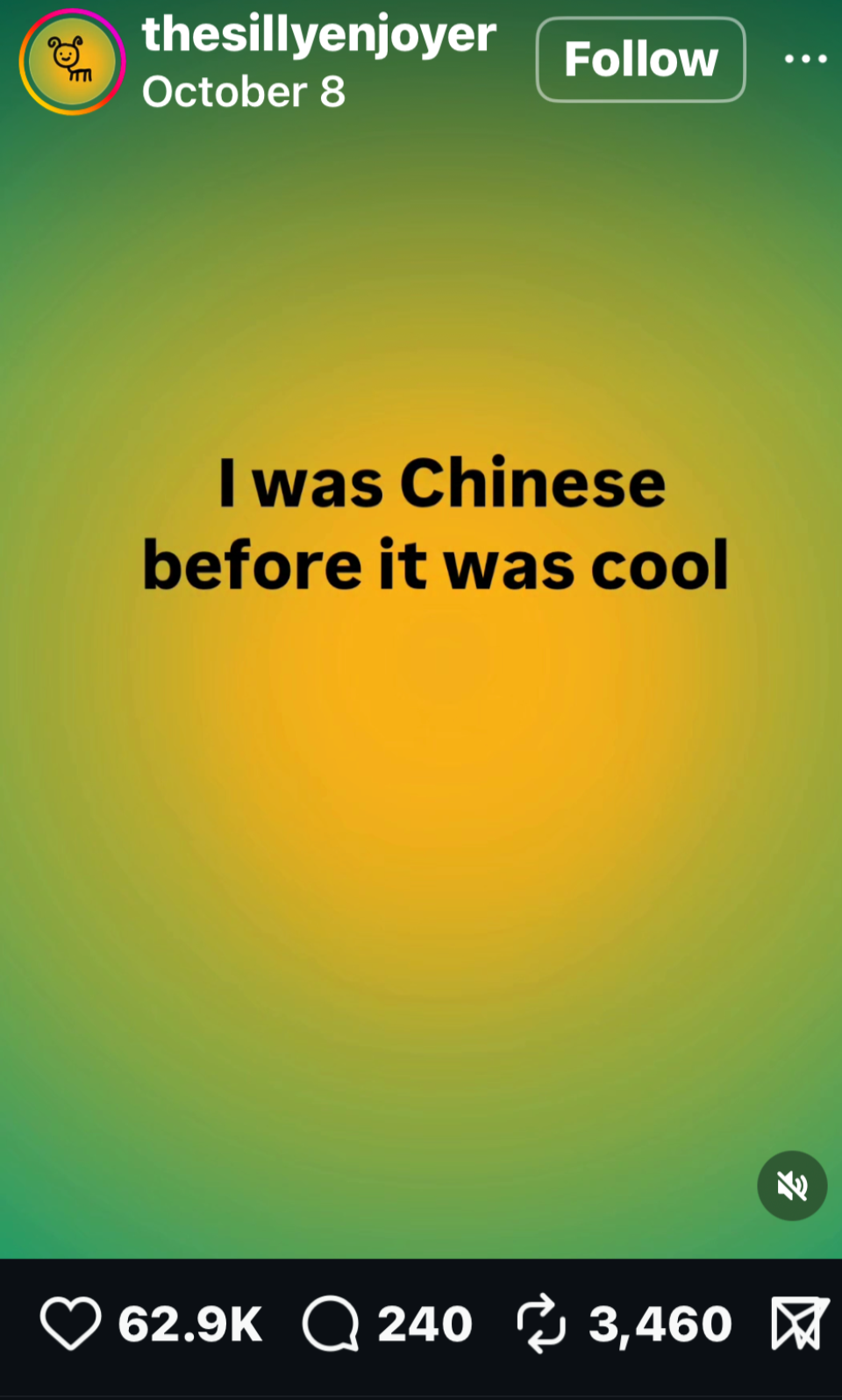
Where is the U.S.’ future? It’s hard to answer. Where is China’s future? Much easier to layer contemporary images of China’s bullet trains and skyscrapers upon decades of techno-Orientalist media like Blade Runner. It’s impossible not to talk about these representations when discussing our contemporary fantasies of the Chinese nation-state. The Western world has always looked for an Other. But this time, its chosen Other doesn’t exist to validate the moral integrity and supremacy of the West, providing catharsis to a Western audience that is both fascinated and horrified by its exoticism.
Instead, China has become an aspirational object. Representations of China are finally beginning to exist in the now, anchored by an influx of Chinese memes and digital interactions between Chinese and non-Chinese netizens, instead of in technological futurity or social backwardness. How ironic that despite this now-ness, China is still painfully out of reach to most Americans.
This is a fascinating inversion, a pivot from the ridicule that once dominated digital discourse about China—and it speaks to the West’s persistent inability to confront itself. It speaks to a desire to be subjugated, to be subsumed by a different identity, because it is easier to do that than to stand up and fight for our own. (For the purpose of this essay, the “West” stands for the powerful owning classes of these countries. We all know that the marginalized among us have been doing the dirty work of confronting, standing up, and fighting for centuries.)
I don’t believe in any nation-state project. No government, much less a foreign government, has any interest in saving you. At best, you can hope for a regime to use you—to extract your talent and labor according to its strategic or market needs—before it forgets about you (or actively targets you!). Look at the U.S. government, which once welcomed aspiring immigrants like my parents, but which has now thrown its full weight behind ICE. China glazers must know this. Yet they still hold out hope, however insincere or absurd, for Xi/Mao/random elderly Chinese kung-fu-master-looking grandpas on Instagram to save them.
At the start of this essay, I talked about a future—a vision for technology—that has been wrested from us on the left, or which was obliterated before it even got to take a form. It takes time to build such a vision, to build the grit and resilience to enact it. You will not wake up one day and see that you’ve suddenly become Chinese. You will not wake up one day and see that you’ve suddenly become anything. 做梦吧! That transformation only comes from long, painful, dirty work. Keep your eyes open while you do it.