
life is iterations & so is blog
One of my favorite things in the world is forming a creative exchange with a friend, especially if they are far away from me. Most recently, Michelle, Monica, and I have started sending each other essays, crafts, and journal entries in a group chat whose title has changed from “Chinese American Lesbians of C8” to “Chinese American Lesbianskunstlers of C8.” I’ve spent years sharing my writing with Asha, Simon, and Jessie, beta-reading their academic and creative projects in exchange. And this winter, after an impromptu return to my hometown of Bellevue, I started sending chapters of a new book to Cecil. We spent the first half of 2026 hammering out the long-form literary projects that have eluded us for years: both of them coming-of-ages, his told through the eyes of a Frankenstein’s monster, mine narrated by two sixteen-year-old girls growing up (and falling in love) in Bellevue.
A lot has happened since I wrote my last blog post: an ode to the literature that shaped me in 2025, the literature that was already pushing me to look beyond the fantasy novel that I had dedicated the first two years of my adult life to completing. Since that January visit to Bellevue, I applied to and was rejected from too many U.K. jobs and scholarships to count. I queried and was rejected by too many literary agents to count. I shelved my fantasy novel during one rather anticlimatic afternoon at a coffee shop, then tried not to feel like I had destroyed part of my soul (read: wasted the entirety of my early twenties on a book that didn’t say anything that important). And at the end of summer, I quit the lucrative part-time job that allowed me to focus full-time on my writing. I returned to Tsinghua to pursue another Master’s degree, this time focused on communication sciences and media policy. When I biked back onto campus—a student again, three years after my graduation from Schwarzman College—I thought, I am really getting too old for this.
All these failures flipped my world upside-down. What can I say? I was too successful at too young of an age—I grew up in the prodigy-factory-pressure-cooker that was Bellevue, after all—and it was about time I was humbled. I clung tight to my friends throughout it all. I hosted art nights, cried ungracefully over FaceTime, and learned a number of new crafts. My blog posts and short-form writing projects became a life raft during this time: freed from the expectations of genre, publication, and prestige, my writing grew in leaps and bounds. Sometimes, I stunned myself with the beauty of my prose. Other times, I made myself laugh out loud: a completely unexpected turn of events, given how seriously I used to take my craft. One day, I promised myself, all this growth would settle into the shape of a book.
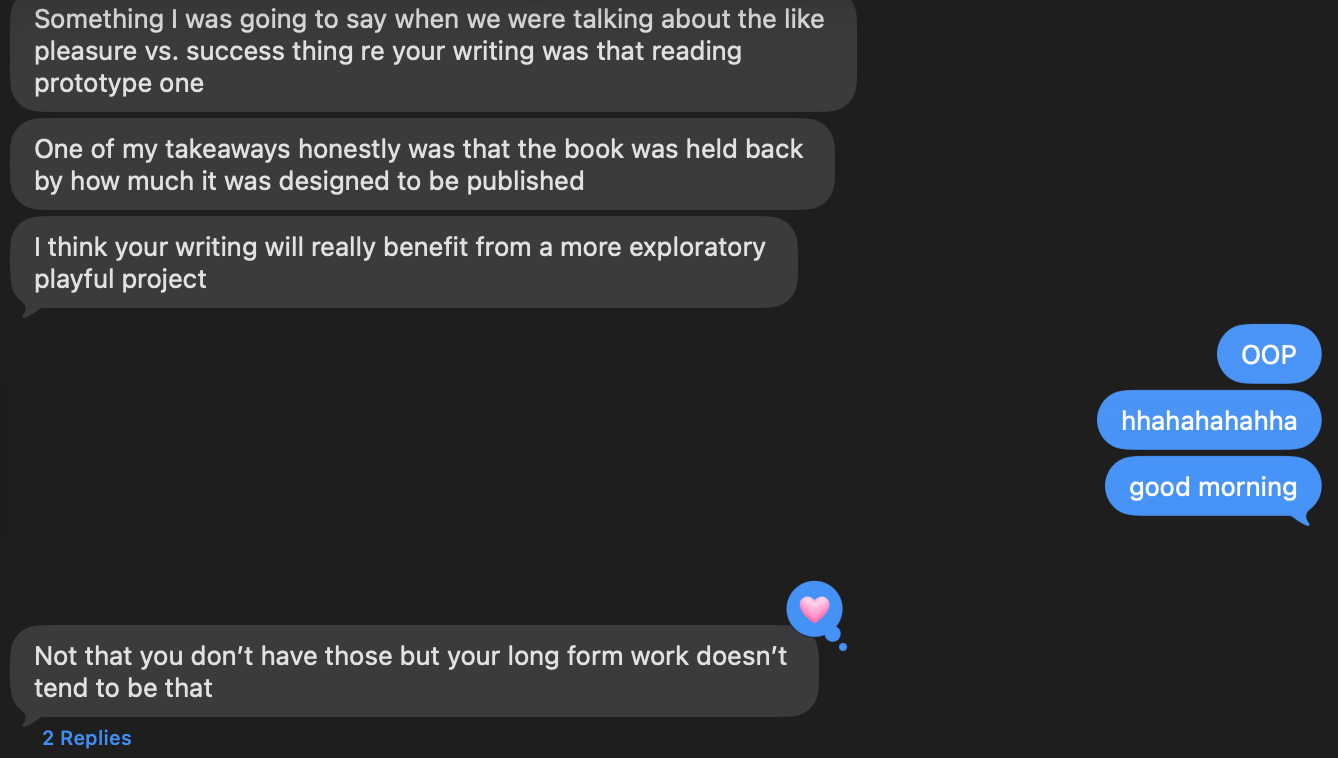
cecil reading me like a book
I recently had a conversation with Simon about love and revolution, how the two are inherently faith-based practices. They both demand a belief in a future that does not yet exist; they both require the stamina and resilience for the iterative processes required to get there. There aren’t many works of literature that recognize, much less attempt to cultivate, this kind of stamina and resilience.
Perhaps this is why I’ve become so disillusioned with fantasy novels about revolution, why I’ve given up on a fantasy novel of my own. Often, these stories build up to a singular moment of revolt or defiance, a climatic showdown that gratifies the audience without questioning what comes after. Much of the literature I loved (and still love!) hinges upon the moment of walking away, of the singular choice to do something different. It is, after all, so hard for us to make that first choice, that first leap of faith. But, as I sit in the aftermath of my own first choice—my era of fucking around and finding out in Beijing—I can’t help but wonder what comes next. One defiant choice is nowhere near enough: not for our own growth, certainly not for revolution. How can art cultivate the strength of will required to make the hard choice, over and over again? How can art guide us through the exhaustion of it?
I’ve been gravitating toward art that doesn’t offer an easy way out, art that often veers toward the tragic. Near the end of summer, I began to obsessively rewatch white ballets, where the prince never wins; and allegorical magical girl animes, where the prince also never wins. It’s no secret that I’ve always seen myself in the figure of these princes—Siegfried from Swan Lake, Utena from Revolutionary Girl Utena, Sayaka from Madoka Magica—more than in any princess. That the death of the prince always gives me a horrible sort of catharsis. When the maiden dies—because the maiden has to die in every white ballet, from Swan Lake to La Bayadere to Giselle—the prince and his innocence and his belief in his own goodness dies too.
White ballets are meant to reflect the psychology of the prince. The maiden, who exists to test and ultimately destroy him, is an illusion refracted across countless identical bodies: a perfectly cruel meta-commentary, given the medium of ballet. Nowhere is this more obvious than in the Royal Ballet’s staging of Swan Lake, where the evil Von Rothbart holds power in both the royal court and at the lake. He turns the maidens into swans, acts as Prince Siegfried’s tutor in order to lure him to the lake, and makes him break his promise to Odette by enchanting him with Odile. His entire plan doesn’t seem to extend beyond destroying Siegfried and hoarding power for himself, sucking up the accumulated innocence and naive hope of countless young maidens and princes. RIP Von Rothbart, you would’ve loved private equity.
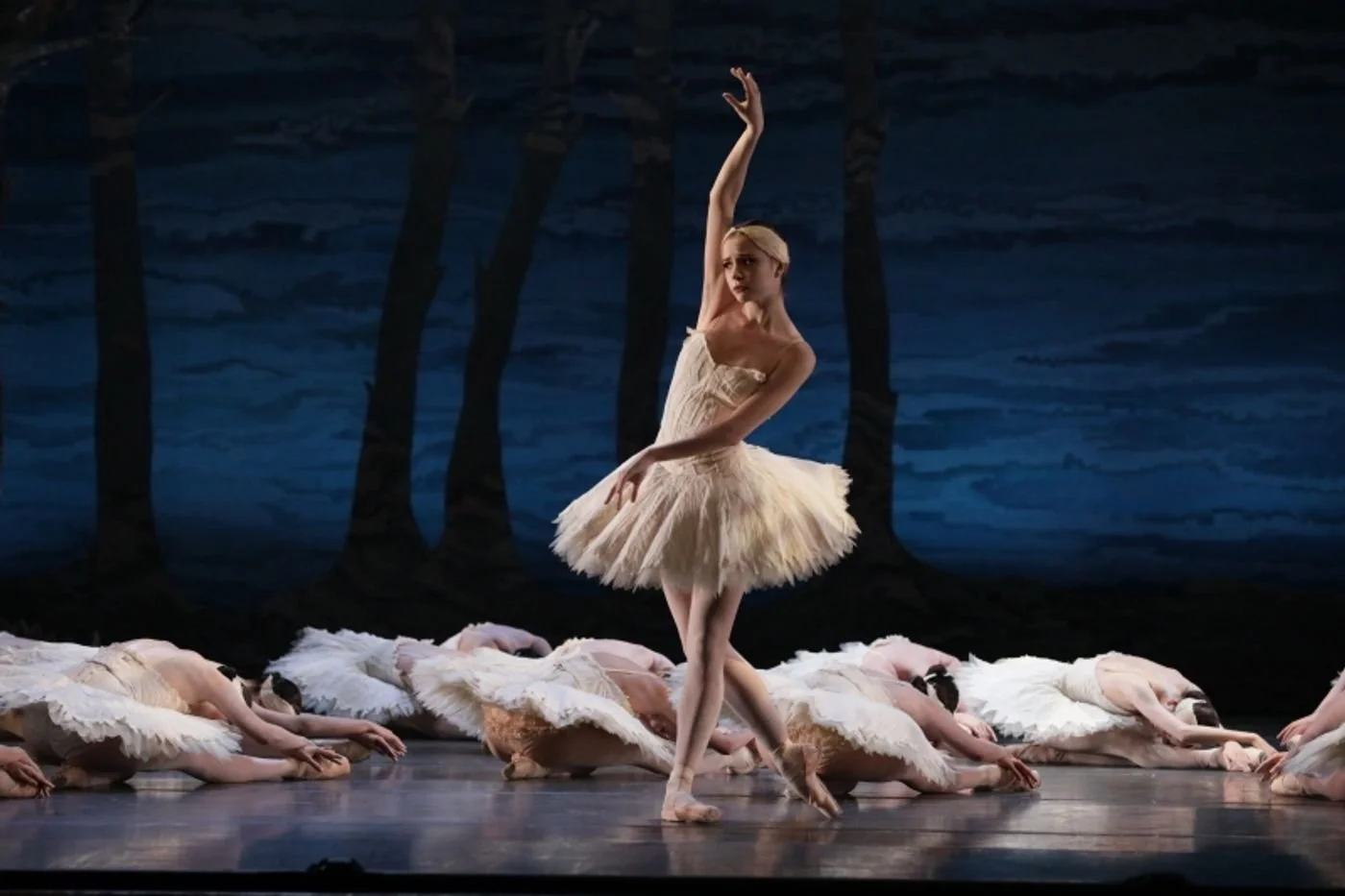
max richter in the houston ballet’s swan lake. they are one of my favorite dancers, especially in this role, because they are so good at messing with gender & femininity. (photo by amitava sarkar)
The first time I watched Revolutionary Girl Utena, I thought immediately of Swan Lake. “All girls are the Rose Bride,” says Anthy. She, the Rose Bride, is given in marriage to whomever can win her hand in a duel. She’s said to hold the power to revolutionize the world, and the entire cast of duelists (variously suppressed teenage students) want to win her for a different reason. When Utena enters the game, she decides that she won’t be like all the other duelists. She will be the one to break Anthy out of this system. Despite her good intentions, she doesn’t truly see Anthy’s humanity—nor does she really want to—until the very end of the show.
Ultimately, Utena fails to save Anthy. She disappears from the world entirely, a punishment (or reward?) for daring to rebel. No one seems to remember her. Everyone is gearing up for the next round of duels. But her kindness and bravery inspire Anthy to finally walk away from her abuser, and in this, she truly is revolutionary.
Of course, things are never so easy. The sequel movie, Adolescence of Utena, begins right back where everything started. Utena starts to duel all over again, with no memory of what happened in the show, and Anthy is bold and tender and heroic in ways she was never allowed to be in the original. The common interpretation of Adolescence, which is equal parts visually stunning and visually confusing, is that it is just the next cycle in a long, long series of cycles involving many, many duelists and many, many Rose Brides. In the cycle that is Adolescence, Anthy and Utena finally break out of the world together, confess their love, and drive (literally—Utena turns into a car) into an unknown land. You’re not a lesbian until you’ve thanked your ex-boyfriend for teaching you to be a prince before letting his ghost drown in the waters of the underworld, or until you’ve let your girlfriend drive your car-form away from a castle that is also her incestuous abuser, or until you’ve driven your girlfriend-car into a world with no roads.
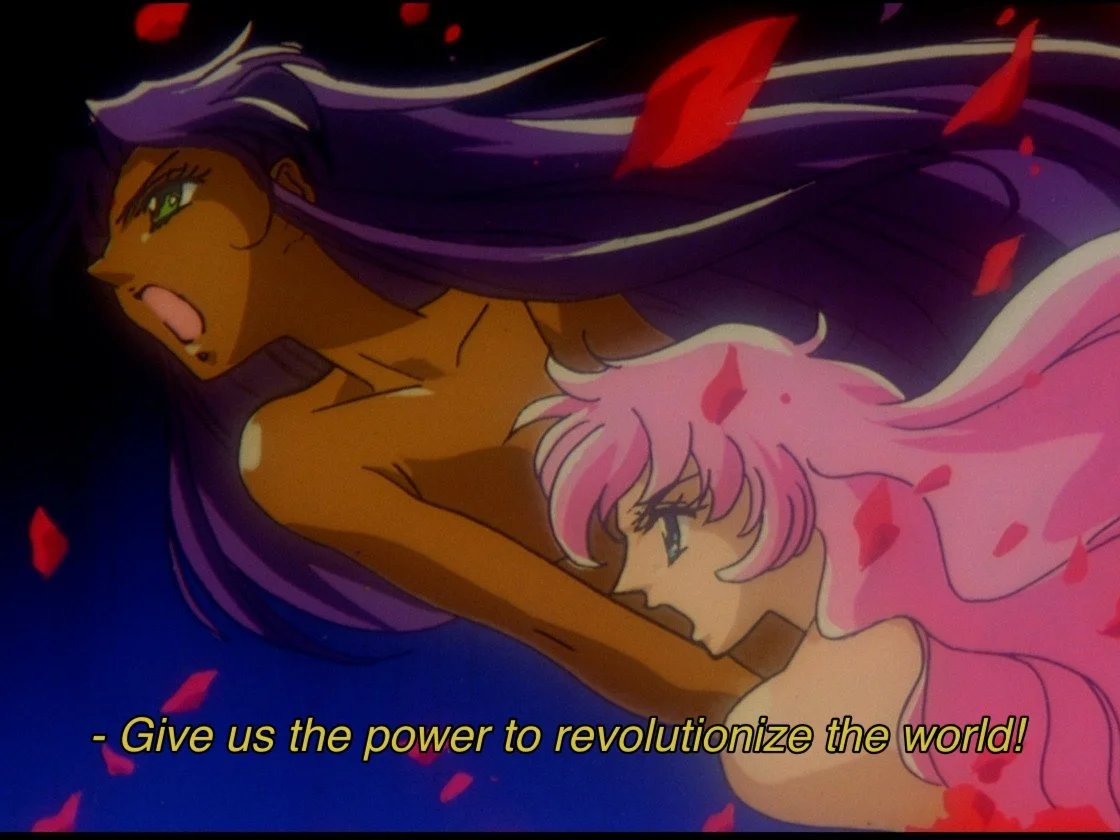
screencap by @himemeiya on tumblr, with the original caption, “Fuck you * unwhitewashes your anthy *”
Maybe, the iteration after this Swan Lake is where Odette and Siegfried finally break free. Maybe, they just need to try and try again, in different doomed timelines, each time getting a little bit closer. After all, if the most popular interpretation of the show and movie are to be believed, it took many iterations of Anthy’s and Utena’s relationship for them to finally see each other (and free each other!). A story like this—frustrating, contradictory, looping around and around on itself—can’t fit into many containers. It doesn’t really fit into a novel or a movie, not the type that has become commercially mainstream today. A television show, with its repetitive theme music and identical transformation sequences; and a white ballet, with its endless rows of dancers and four-act structure, might be the best way to tell a story about these cycles, about the long and arduous process of revolution. Not to make it about me, but this does put me in a hard spot—I still want to make a living off novels, after all, and I can’t build a career off the 300K-word multi-installment fanfictions that I wrote in my teens. Ah!!
This summer, Asha completed her Master’s dissertation on the lesbian omegaverse fanfiction of The Untamed, the show that gave me permission to be evil and gay when I was nineteen. She wrote about the intertextual, networked nature of fanfics: how they build off, critique, and exist in conversation with each other, creating an iterative body that resides in a very unique timespace. Many possibilities exist simultaneously in this timespace, and a giant canon of fanfiction may be building toward a point at the same time that it is moving away from it, expanding in many different directions toward many different futures and conclusions. She writes:
“Gardiner argues that gender is a “cultural fantasy” (2012:610); she reiterates the constructed nature of the gender binary. Yet culture changes, fantasy is subjective—we’ve seen this in the differing interpretations of gender norms and expectations even across the microcosm of the lesbian Modao Zushi omegaverse. If fantasy is what one makes of it, then who’s to say that in this text, in the next, maybe eventually, we cannot fantasise about utopic gender instead, construct gender in new alternative ways? The anonymous author affirms this ambiguity in ‘Oh you’re mine’: “I love you, all of you, every you. There is all the time in the world,” Lan Wangji says to Wei Wuxian (anonymous:2021). In her love, “all” and “every” iteration of Wei Wuxian is recalled, queered, touched, reimagined. “Who can I become?” Butler questioned earlier (2001:621). In this dissertation, I have argued that for these characters, in these texts, it is not the answer to the question which matters but the conditions that allow them to keep asking.”
(McGrogan 2026, “Legitimating Lesbian Genderqueerness Online: How Networked Modao Zushi Omegaverse Fanfiction Produces Alternative Gender Imaginaries.”)
This is not to say that fanfiction is an inherently revolutionary medium/method, or that the revolution will be built by fanfic writers. But this is to say that fanfiction is a medium so wholly welcoming of iterations and adaptations, where the cycles contained in one story might be fractured infinitely outwards in endless reproductions and adaptations, that it is difficult not to see fanfiction as a medium/method generous enough to model a search for a future, or a space where we may develop the patient, curious, and dogged qualities needed for this search. At this time in my life—when I have lived just long enough to start understanding the iterations of my becoming and the stamina required to see them through—this is very comforting. It’s been ten years since I last opened Wattpad, but I’ve started writing like a fanfic writer again: imbuing my work with open questions and inside jokes; trusting that it is okay to leave things hanging; reaching for and being held by my friends, by my fellow writers and artists, by an endless body of literature.
Sometime at the start of September, I finished the coming-of-age-Bellevue-novel that I began this winter. I had originally conceived of the book as a speculative horror project about big tech pipelines and suburbia, but I ended up focusing on the minutiae my protagonists’ lives instead. I wanted to honor the humanity of the prodigy child, to capture the ache of growing up queer and Chinese in a suburb with a very short memory—and, more than anything, I just wanted to have fun. None of my hometown friends were spared the singular, soul-crushing focus of Gifted Kid childhood, but our adolescence was always full of laughter. We always knew the absurdity of what it demanded of us. I don’t know whether this is the book that will launch my literary career, but I do know that I—and the twenty-something friends who have poured their love and feedback into my inbox—have found something true within it. For the very first time in my life, I know what it means to do good work, and I’ll carry this knowledge into whatever I do next.
I am back at Tsinghua now, after three years away, and I have changed so fundamentally that my fourth Beijing autumn bears almost no resemblance to the first. But I’ve kept asking, anyways. I’ve kept trying, as are many of us, to get to a better and kinder world, even as our progress stagnates or loops. The gingkos turn gold, another prince dies, and different duelists compete for the hand of the Rose Bride. Still, we keep moving, walking in spirals toward something better.